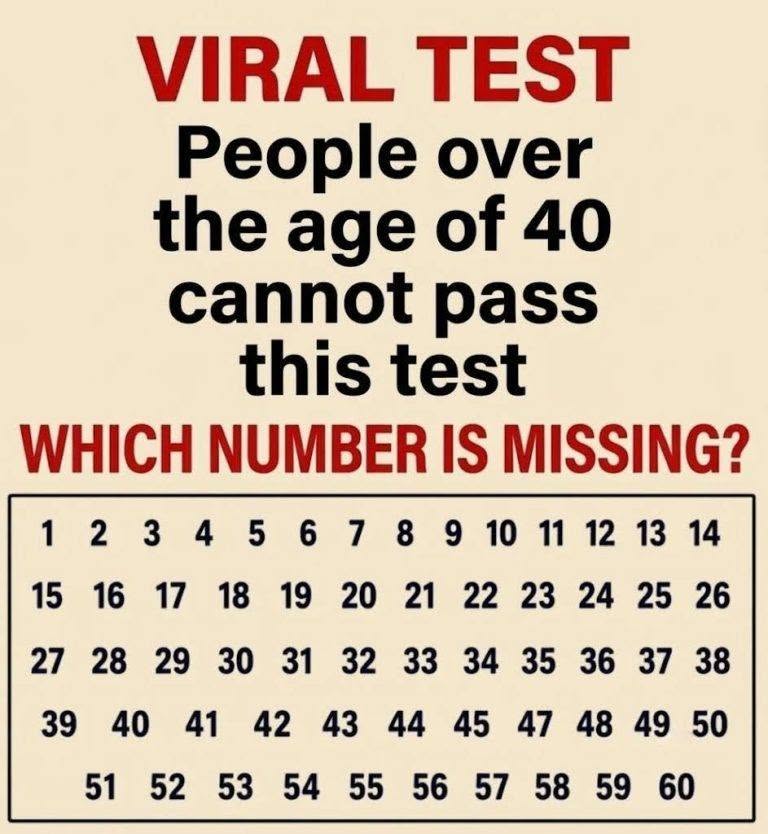
At first glance, this puzzle seems almost too easy. A grid displays numbers in order, beginning with 1 and ending with 60. The challenge is simple: look closely and find the number that has been left out.
Yet many people scan the image several times without noticing the answer. Why? Because the sequence looks familiar. Our brains are quick at recognizing patterns, and once we believe we know what we are seeing, we may read the numbers as a sequence rather than inspect every one individually. The gap can hide
in plain sight.
Take a moment before reading on. Start at the top left of the grid and follow each row from left to right. Don’t try to solve it all at once. Instead, check how each number connects to the next. When you reach the fourth row, pay close attention: that is where the sequence changes.
The missing number is 46.
The fourth row moves from 45 directly to 47. Since 46 belongs between them, it is the number omitted from the grid. The rest of the sequence continues
It is a small gap, but that is exactly what makes the puzzle effective. The image gives us a strong clue: the numbers are arranged in familiar order. That orderly layout encourages us to expect the next number before we have actually checked it. If we glance quickly, our minds may silently supply the missing 46 and move on. We may feel that we have read every number when, in fact, we have followed the
pattern we expected to see.
This habit is useful in everyday life. The brain constantly sorts information, notices familiar shapes, and fills in details so we can understand the world efficiently. We do not need to study every letter in a familiar word or every step in a routine task. Pattern recognition helps us read, navigate, and make quick decisions. But the same shortcut can sometimes cause us to overlook a detail that does not fit.
That is why a simple number puzzle can be more challenging than it first
appears. The difficulty is not advanced mathematics. There is no complicated formula, hidden code, or special knowledge required. The answer comes from slowing down, paying attention, and resisting the urge to assume that the sequence is complete just because it looks orderly.
If you found 46 immediately, well done. You noticed the break before your eyes moved past it. If it took a little longer, there is no need to worry. A quick puzzle like this is meant to be entertaining, and missing the number on the first glance does
not say anything definitive about your intelligence or your eyesight. The headline’s claim that people over 40 cannot pass the test is designed to make the image more dramatic and encourage people to take part. It is not a genuine age-based vision test.
The best way to approach puzzles like this is to use a steady method. Scan one row at a time. Check the numbers in order rather than looking at the whole grid as a single picture. If a sequence should increase by one each time, compare neighboring
numbers and watch for any unexpected jump. In this case, the jump from 45 to 47 reveals the missing number.
Now it is your turn to share the challenge. Did you find the missing number before reaching the answer, or did you have to check the fourth row twice? Send the puzzle to a friend or family member and see how quickly they spot the gap. You can even ask them to explain how they searched: did they count every number, follow the rows, or notice the jump right away?
Small puzzles are fun because they turn an ordinary moment into a test of attention. A page of numbers can look predictable, yet one missing detail is enough to make us pause and look again. The lesson is simple: when something seems obvious, taking a closer look can reveal what a quick glance missed.
So, the next time you see a familiar pattern, don’t let your eyes race ahead of the details. Follow the sequence, check the gaps, and trust what is actually on the page. In this viral test,
the missing number is 46. Did you spot it?
