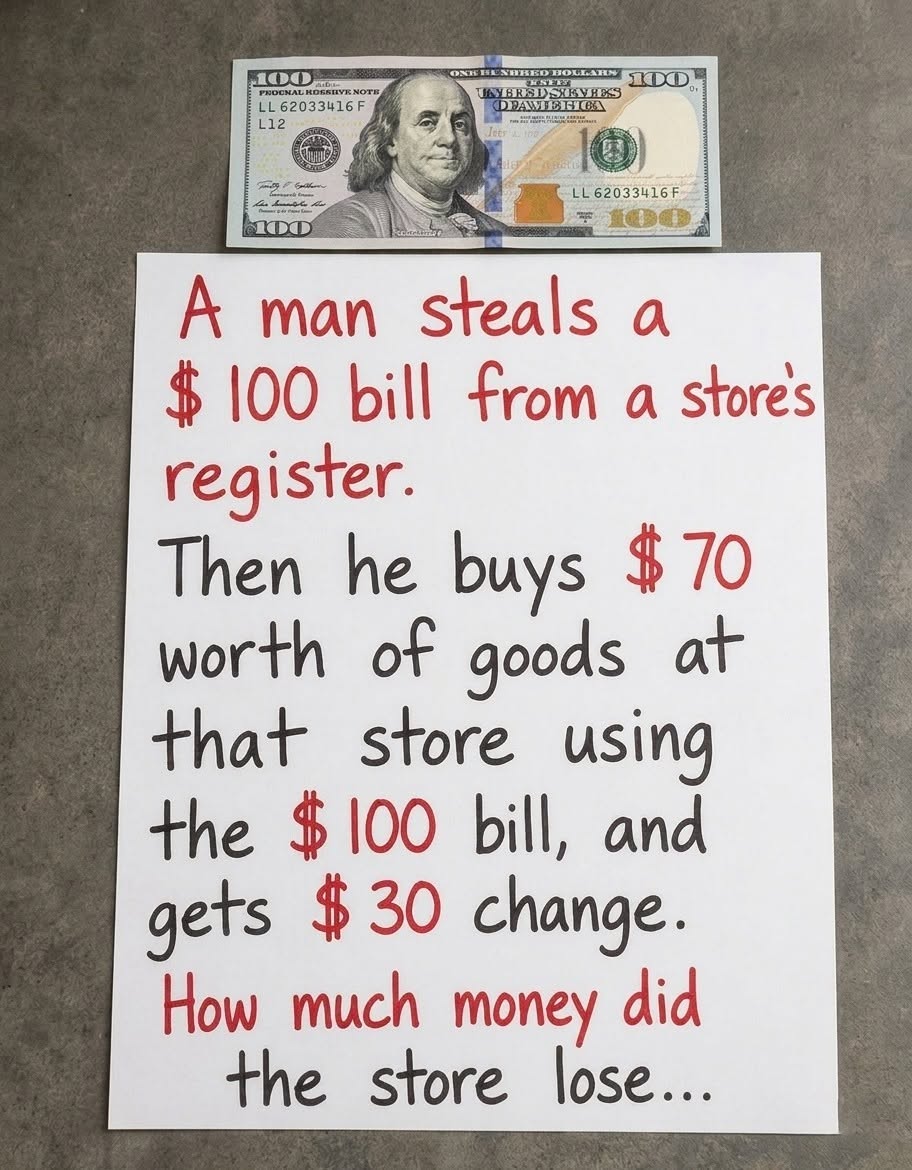
This type of headline is a classic example of a viral math riddle designed to challenge assumptions and test logical reasoning. While the exact numbers vary by version, the core puzzle usually goes like this:
🧠 The Classic Riddle:
A man walks into a store and steals a $100 bill from the register while the owner isn’t looking.
He then uses that same $100 bill to buy $70 worth of goods, paying with the stolen money.
The owner gives him $30 in change.
How much did the store lose?
Most people guess $200 ($100 stolen + $70 goods + $30 change) or $130—but the correct answer is simpler.
🔍 Breaking It Down (Step by Step)
Let’s track only what the store lost:
- The thief took $100 in cash → Store is down $100.
- He returns and buys $70 of goods using that same $100 → The store gets the $100 bill back…
- But gives away $70 worth of inventory
- And gives $30 in real change from the register
So net loss:
- $70 (goods) + $30 (cash given as change) = $100 total loss
💡 The stolen $100 bill is just a tool—it circulates back. The real loss is what the store gave without receiving value: $70 in products + $30 in cash.
❌ Why People Get It Wrong
“The mind sees complexity where simplicity lives.”
Puzzles like this don’t measure intelligence—they reveal how easily we overcomplicate things when distracted by surface details. The truth is often hidden in plain sight, waiting for calm attention.
So next time you’re faced with a “trick” question:
Pause. Strip away the noise. Follow the value.
Because clarity isn’t about knowing more—it’s about seeing clearly. 💡✨
