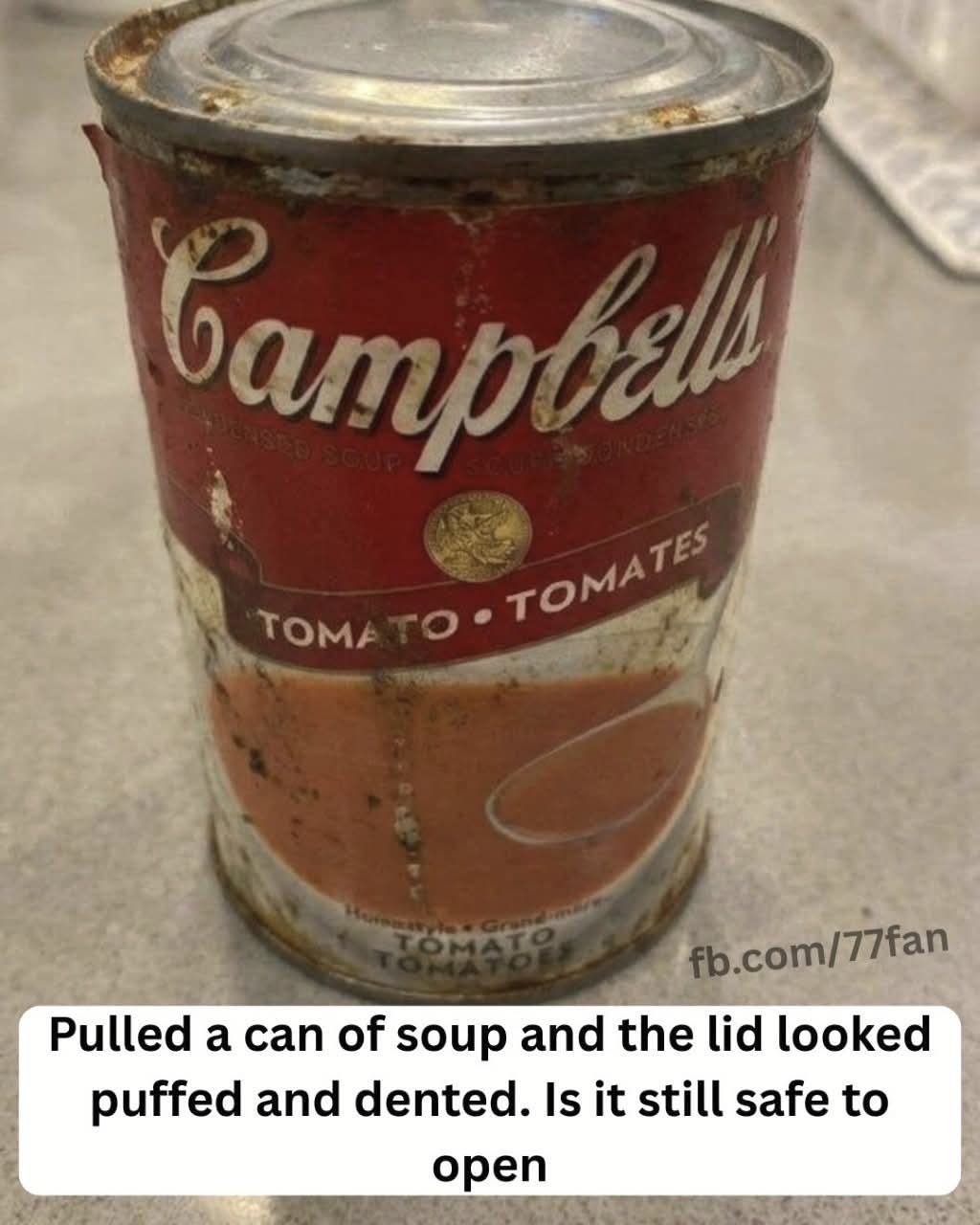
I had already grabbed the spoon.
That’s how close I was.
It was just a regular can of soup sitting in the pantry—nothing unusual. But when I turned it in my hand, something felt off. The lid looked… slightly raised. Not dramatic. Just enough to make me pause.
And that pause? Probably a good thing.
Because here’s the truth—when a can looks even a little “wrong,” it’s usually not something to ignore.
That puffed lid isn’t random
At first glance, it might not seem like a big deal.
Maybe it got knocked around. Maybe it’s just the packaging, right?
Not really.
A puffed lid usually means there’s pressure building inside the can—and that pressure doesn’t come out of nowhere. It’s often caused by gases produced by bacteria growing inside.
And once that happens… the food inside isn’t in a safe, sealed environment anymore.
Dents can be just as tricky
Now dents—those are a little more confusing.
Because not all dents are dangerous.
A small dent on the side? Usually fine.
But if it’s deep, sharp, or sitting right along the seams or the lid… that’s where things get risky.
That kind of damage can weaken the seal—sometimes in ways you can’t even see—and that’s all bacteria need.
So yeah, not every dent is a problem. But some absolutely are.
I Almost Opened That Can… Until I Noticed the Lid Was Puffed
What’s actually happening inside the can?
Here’s the part people don’t always realize.
Canned food is safe because it’s sealed tight—no air, no bacteria, no activity.
But if that seal breaks—even slightly—microorganisms can start doing what they do: growing, fermenting, producing gas.
That’s what causes the swelling.
And in some cases, it can lead to bacteria like Clostridium botulinum, which produces toxins you definitely don’t want anywhere near your food.
